
Is Aadhaar compulsory for flat registration in Mumbai? Resale guide for buyer and seller
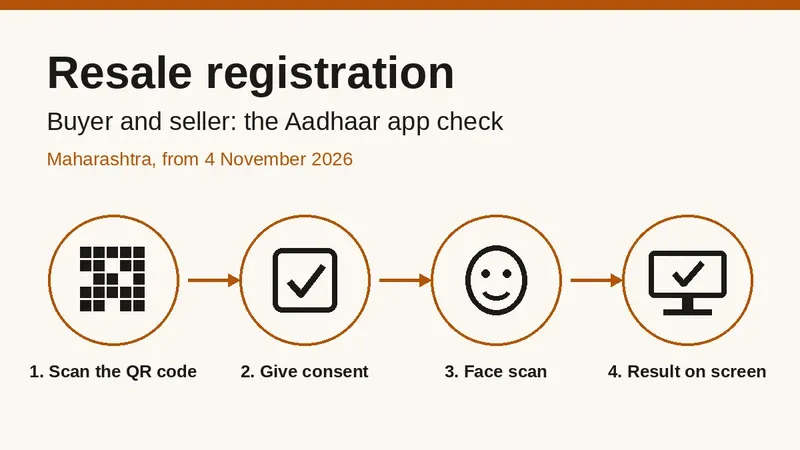
In a resale, the registration appointment is the moment money and keys change hands. Since 4 November 2026 it can stall on something small: one joint owner whose Aadhaar app does not open. Maharashtra now registers a property document only after every person in it has passed Aadhaar authentication, and the witness who used to cover a failed check is no longer accepted.
We wrote a short note when the rule was announced. This is the full walk-through for the two sides of a resale transaction.
The rule in three lines
- From 1 October 2026, Aadhaar authentication is compulsory for 63 categories of property documents in Maharashtra, including sale, purchase, mortgage and partition deeds.
- From 4 November 2026, the registration system (iSARITA 1.9) accepts face authentication done on the UIDAI Aadhaar app, alongside fingerprint and iris scans.
- From the same date, an "identifier" can no longer vouch for someone whose check has failed. Everyone passes personally, at the office.
Why resale deals are more exposed than most
A resale flat often has more signatures than people expect. The flat may be held by two brothers, or by a mother and a son who has since moved away. One seller may be in their eighties. Each of them now needs a working Aadhaar check on the day, and the buyer's side needs the same.
The department's Deputy Inspector General of Registration has said the Aadhaar holder must be physically present at the office. A seller cannot complete the check from another city.
For the seller: prepare every owner on the title
- Write down every owner who will sign. Include joint holders and anyone signing as a confirming party.
- Check each owner's Aadhaar-linked mobile number. The app verifies the SIM in the phone. A number given up years ago has to be updated with UIDAI before anything else works.
- Install the Aadhaar app on each owner's phone. It runs on Android 9.0 and later and iOS 16 and later.
- Complete registration, SIM verification and face authentication in the app. Do it at home, in good light.
- Set the six-digit PIN and write it somewhere safe. Older owners forget it more than any other step.
- Unlock biometrics. Many careful people lock their Aadhaar biometrics. It has to be unlocked in the app before the appointment.
For the buyer: the same six steps, plus your lender
Every buyer named on the deed follows the same set-up. If you are taking a home loan, tell the bank's representative the date only after both sides confirm their apps are working. A cancelled slot can mean a fresh disbursement date.
At the sub-registrar office
- The officer brings up a QR code on the office computer.
- The person opens the Aadhaar app with their PIN and scans it.
- The app asks for consent to share identity details for this registration.
- The person completes a face scan on their own phone.
- The result shows on the officer's screen. The next person does the same.
Fingerprint and iris scanners are still there. An early description of the system said the office tries the fingerprint first, then the iris scan, and uses the app where those cannot be completed. Later reports do not give an order, so carry a ready phone whatever the office prefers.
Situations to settle before you fix the date
- An owner who lives abroad. The published reports say nothing about non-resident sellers or buyers. Ask the sub-registrar office or your lawyer in writing.
- Signing through a power of attorney. Also not addressed in the reports. Do not assume the holder's own check is enough.
- An owner with no Aadhaar. In October, reports said other government identity and proof of enrolment would be accepted, and that nobody would be refused only for lacking Aadhaar. Whether that still holds after 4 November is not stated.
- An owner who cannot manage a phone. Set the app up on a phone with their SIM and do a practice run. A family member can help them hold the phone, but the face and the consent must be theirs.
A simple timeline
- Ten days before: both sides list their signatories and check Aadhaar-linked numbers.
- One week before: apps installed, face set-up done, biometrics unlocked.
- Two days before: each person opens the app once with their PIN. Only then confirm the slot.
- On the day: charged phones, mobile data on, original Aadhaar details at hand.
Common questions
What happens if the seller's check fails at the office?
The deed is not registered until it passes. There is no witness route any more, so the appointment is usually lost.
Do both buyer and seller need the app?
Every person taking part must pass Aadhaar authentication. The app is one of three ways, with fingerprint and iris.
Does this change stamp duty or registration fees?
No. It changes how identity is checked, not what you pay.
Based on published reports of the Registration and Stamps Department's rules as of 17 November 2026. We have not seen the official order. Check unusual cases with the sub-registrar office.