Major Developers Intensify Race for Mumbai Cluster Redevelopment Projects
Major Developers Intensify Race for Mumbai Cluster Redevelopment Projects
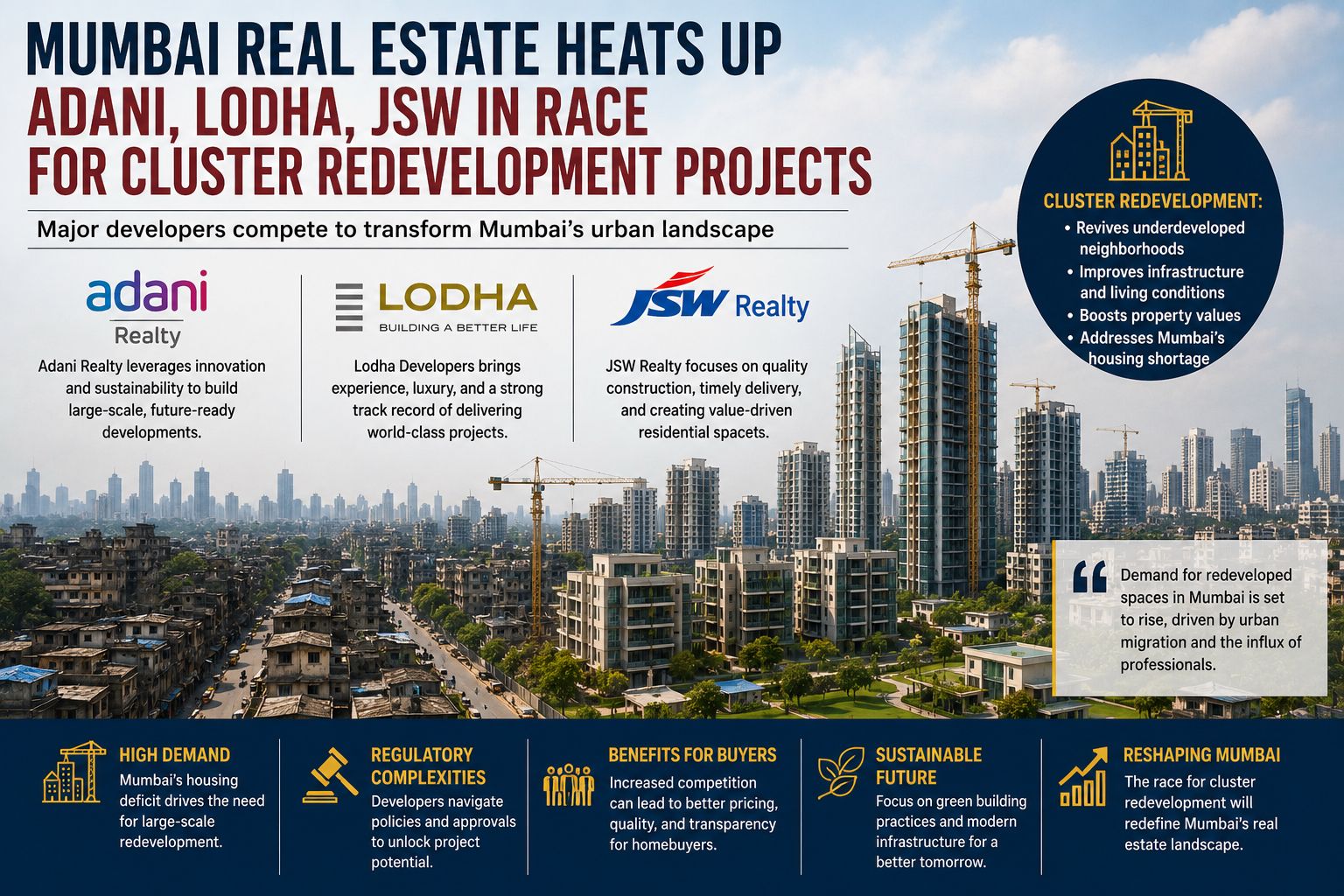
Competition for cluster redevelopment projects is increasing across Mumbai as some of the country's largest developers pursue opportunities to transform ageing neighbourhoods into modern residential and mixed-use communities. With limited greenfield land available within city limits, cluster redevelopment has emerged as one of the most significant growth avenues for the real estate sector.
Unlike traditional redevelopment projects that focus on individual buildings or housing societies, cluster redevelopment allows planners and developers to renew entire localities through a coordinated approach. The model is increasingly viewed as a practical solution for improving infrastructure, increasing housing supply, and upgrading living conditions in densely populated urban areas.
As Mumbai continues to grapple with housing shortages and ageing building stock, cluster redevelopment is becoming central to the city's long-term development strategy.
Why Cluster Redevelopment Matters for Mumbai
Mumbai's urban landscape contains numerous older neighbourhoods that were developed decades ago and now require significant upgrading. Redeveloping individual buildings can improve living conditions for a limited number of residents, but it often does little to address broader infrastructure challenges.
Cluster redevelopment takes a larger view by planning entire precincts together. This approach creates opportunities to widen roads, improve drainage networks, enhance public spaces, introduce community facilities, and create better overall urban environments.
By integrating housing and infrastructure improvements, cluster redevelopment can deliver benefits that extend well beyond individual buildings.
Addressing Housing Shortages Through Urban Renewal
Mumbai continues to face a substantial housing deficit while accommodating a growing population and expanding economy. Creating additional housing supply within an already built-up city requires innovative approaches that maximise the use of existing land.
Cluster redevelopment allows authorities and developers to unlock development potential across larger areas while rehousing existing residents in modern accommodation. The process often generates additional residential inventory, helping to address housing demand without requiring large tracts of new land.
As a result, cluster redevelopment is increasingly viewed as one of the most effective tools for expanding housing supply in the city.
Why Developers Are Pursuing Large Redevelopment Projects
Large redevelopment projects offer developers an opportunity to participate in long-term urban transformation while creating significant residential and commercial inventory. Such projects often span multiple years and can have a meaningful impact on the surrounding area's development trajectory.
Because cluster redevelopment covers larger areas than conventional projects, developers can adopt more comprehensive planning approaches that integrate housing, infrastructure, open spaces, and community facilities. These projects also provide opportunities to create modern urban environments that align with changing buyer preferences.
The growing interest from major developers reflects confidence in both Mumbai's housing demand and the long-term potential of redevelopment-led growth.
Benefits for Residents and Communities
One of the most important advantages of cluster redevelopment is its potential to improve quality of life for existing residents. Redeveloped communities typically benefit from safer buildings, modern amenities, improved infrastructure, and better public facilities.
Residents often gain access to upgraded homes while remaining within familiar neighbourhoods. The broader community can also benefit from enhanced roads, utilities, public spaces, and social infrastructure that would be difficult to achieve through piecemeal redevelopment.
This combination of housing renewal and infrastructure improvement makes cluster redevelopment particularly attractive from an urban planning perspective.
Infrastructure and Planning Take Centre Stage
Successful cluster redevelopment requires careful planning and coordination between multiple stakeholders, including residents, developers, government agencies, and urban planners. Large-scale projects provide an opportunity to address infrastructure deficiencies that have accumulated over time.
By planning entire precincts together, authorities can create more efficient transportation networks, improve utility services, and ensure that future development is supported by adequate civic infrastructure. This integrated approach helps create more sustainable and liveable neighbourhoods.
Infrastructure improvements are therefore often as important as the housing created through redevelopment.
What It Means for Homebuyers
For homebuyers, cluster redevelopment can result in the creation of modern housing within established urban locations. These projects often combine the advantages of mature neighbourhoods with the benefits of contemporary construction standards and amenities.
As redevelopment activity accelerates, buyers are likely to see an increasing number of new housing opportunities emerge from transformed urban precincts. The addition of modern residential inventory may also improve housing choice across different parts of the city.
For long-term buyers, redevelopment-driven neighbourhoods can offer strong value supported by upgraded infrastructure and improved urban environments.
Expert View
"Cluster redevelopment is one of the most powerful tools available to Mumbai for addressing housing shortages and urban infrastructure challenges simultaneously. By planning larger areas together rather than redeveloping buildings individually, the city can create better neighbourhoods, improve civic infrastructure, and generate meaningful new housing supply. The increasing interest from major developers reflects the importance of this model in Mumbai's future growth." — Sandeep Sadh