
Maharashtra Decentralises Land Regularisation Powers to District Collectors
Maharashtra Decentralises Land Regularisation Powers to District Collectors
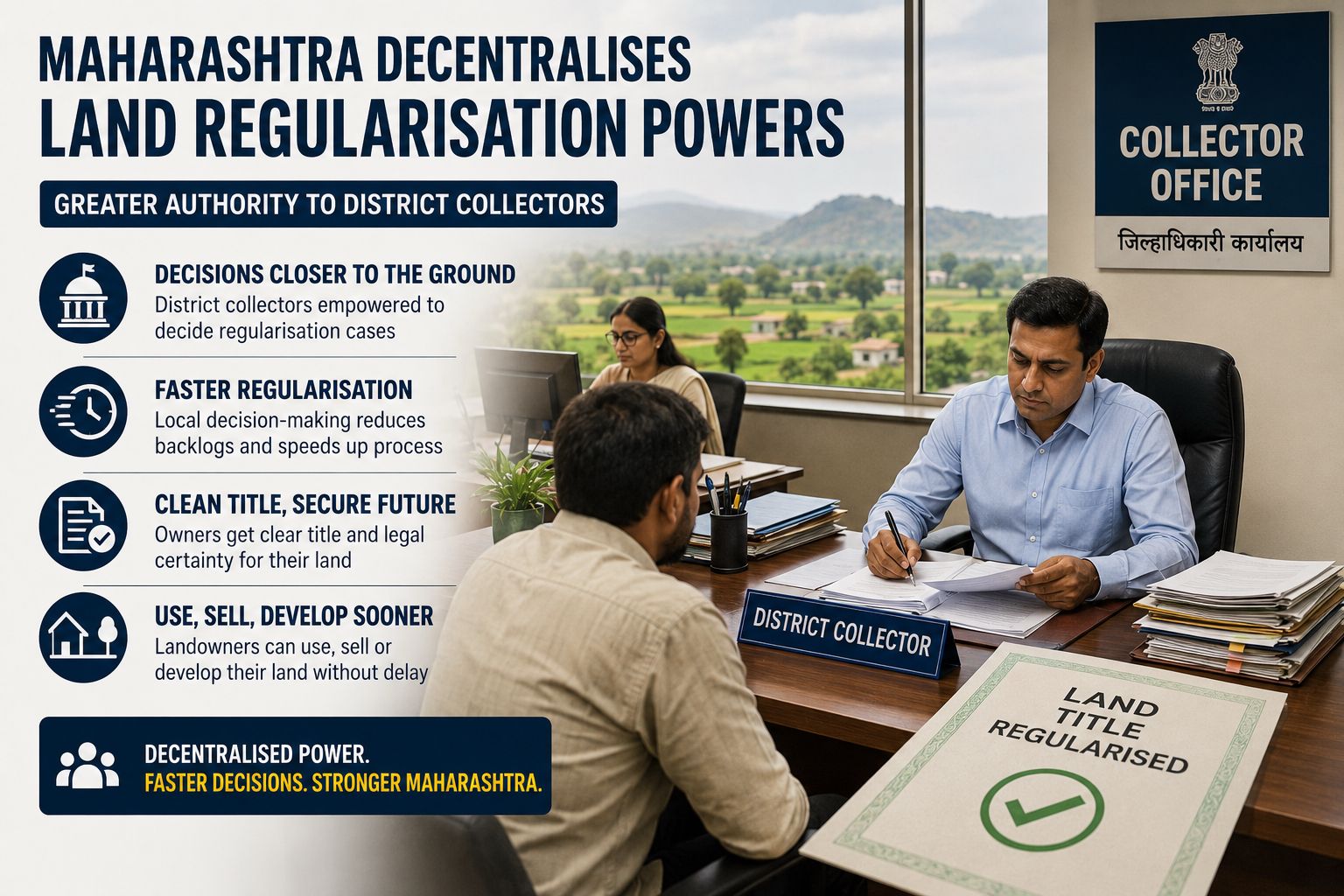
The Maharashtra government has decentralised land regularisation powers by granting district collectors greater authority to handle and approve land regularisation cases. The decision is expected to reduce administrative bottlenecks, speed up decision-making, and simplify processes for landowners seeking to resolve title-related issues.
Land regularisation plays a critical role in bringing properties with unclear, restricted, or pending land-use status into the formal system. Delays in approvals can often prevent landowners from fully utilising their properties, transferring ownership, or pursuing development opportunities. By empowering local authorities, the government aims to improve efficiency and accelerate the resolution of pending cases.
The move is particularly significant in a state where urban expansion, infrastructure projects, and redevelopment activity continue to increase demand for legally clear and development-ready land.
Why Land Regularisation Matters
Land regularisation is the process through which properties with unresolved land-use, ownership, or title-related issues are brought into compliance with applicable regulations. Clear title and proper documentation are essential for property transactions, financing, development approvals, and long-term ownership security.
When land records remain unresolved, owners may face difficulties in selling, transferring, mortgaging, or developing their properties. Such uncertainties can also affect marketability and reduce the overall value of the asset.
Regularisation helps remove these obstacles by ensuring that properties are properly documented and recognised within the legal framework.
How Decentralisation Can Speed Up Approvals
Centralised approval systems often result in delays when large volumes of applications are routed through a limited number of decision-making authorities. As applications accumulate, processing times can increase, creating uncertainty for landowners and slowing down development activity.
By delegating greater authority to district collectors, the government aims to bring decision-making closer to the local level. District officials are often better positioned to understand regional land issues, assess applications more efficiently, and resolve cases without lengthy administrative procedures.
The decentralised approach is expected to reduce backlogs and improve turnaround times for applicants across Maharashtra.
Benefits for Landowners and Developers
For property owners, faster land regularisation can provide greater certainty and unlock the full potential of their assets. Once title-related issues are resolved, owners may find it easier to sell, transfer, finance, or develop their land.
The move can also benefit developers who often require clear land records before initiating residential, commercial, or infrastructure projects. Faster approvals can reduce project delays and improve the efficiency of the development process.
In a market where legal clarity is a critical factor in property transactions, streamlined regularisation procedures can contribute to greater confidence among stakeholders.
Impact on Maharashtra's Real Estate Market
Clear land titles and efficient approval processes are essential for a healthy property market. Properties that are fully regularised are generally easier to transact, finance, and develop, supporting overall market activity.
As Maharashtra continues to witness redevelopment, urban expansion, and infrastructure-led growth, the ability to resolve land-related issues more quickly can help bring additional land parcels into productive use. This can support future housing, commercial development, and investment opportunities across the state.
The decentralisation of powers also reflects a broader effort to improve governance and make property-related processes more accessible and efficient.
Expert View
"Land title clarity is one of the foundations of a strong real estate market. Empowering district-level authorities to handle regularisation can significantly reduce delays, improve administrative efficiency, and help landowners unlock the full value and utility of their properties." — Sandeep Sadh