Mumbai Suburban Collector's Office Demolishes 220 Illegal Godowns, Reclaims 14-Acre Plot Along Ghatkopar-Mankhurd Link Road
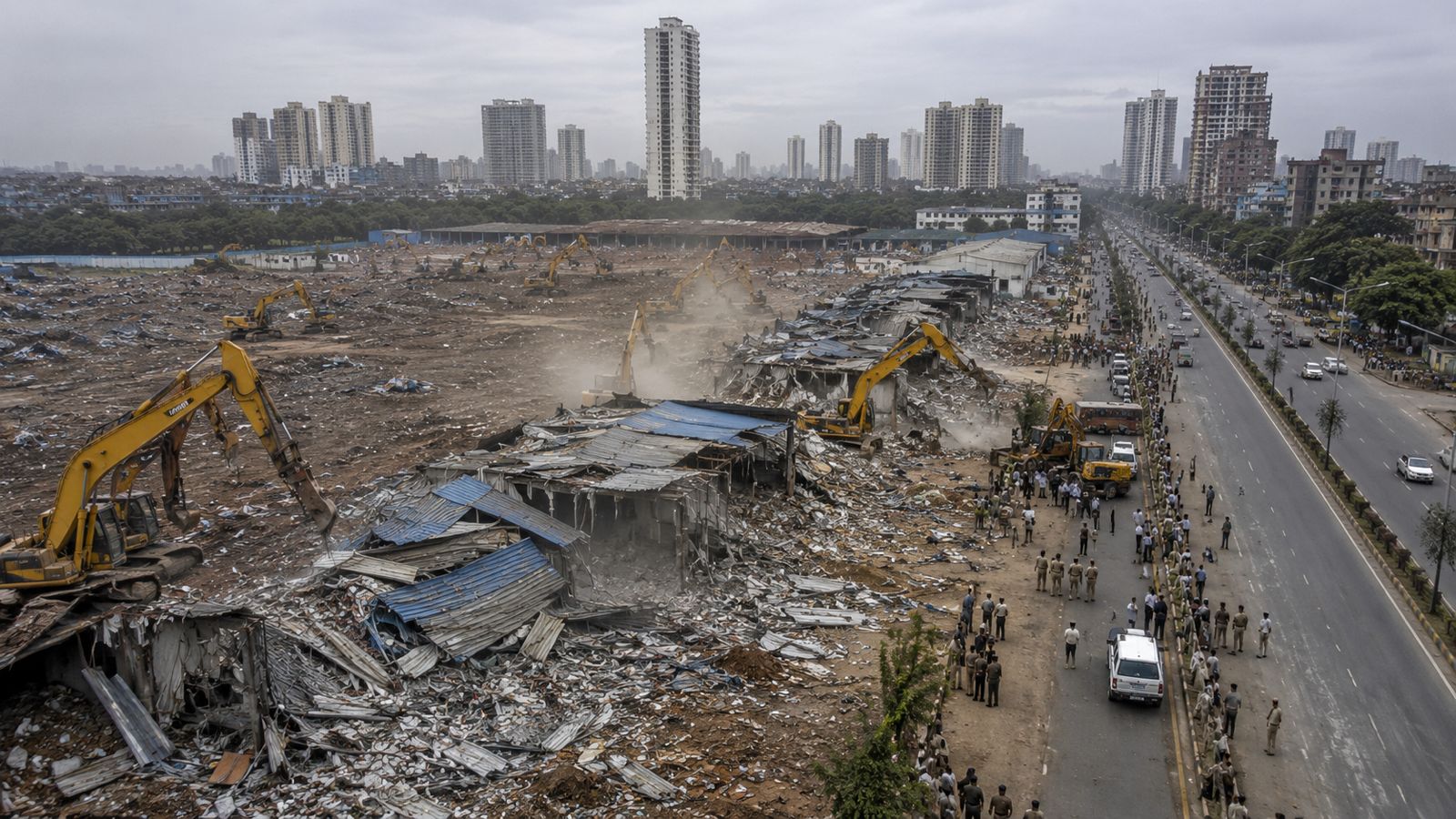
In one of the largest anti-encroachment actions in Mumbai's eastern suburbs this year, the Mumbai Suburban Collector's office has demolished approximately 220 illegal godowns built on a 14-acre government plot along the Ghatkopar-Mankhurd Link Road (GMLR). The operation marks another decisive step in the administration's ongoing campaign to reclaim public land along one of the city's most strategically important road corridors.
A Coordinated Crackdown
The demolition drive was carried out by the district administration in coordination with the Brihanmumbai Municipal Corporation, with heavy machinery including excavators and earthmovers deployed at the site. A substantial police presence ensured the operation proceeded without disruption, a standard feature of recent large-scale clearances in the Mankhurd belt.
The unauthorised warehouses had come up over the years on government-owned land flanking the link road, with many reportedly being used for commercial storage and allied activities without any legal sanction. Officials had served notices to occupants before the structures were brought down under the provisions of the Maharashtra Land Revenue Act, which empowers the collectorate to remove encroachments from government land.
Part of a Larger Campaign
The latest action follows a series of aggressive clearance drives along the same corridor. Earlier this year, the administration removed well over a thousand unauthorised hutments from government land in Mankhurd, freeing more than 11 acres in a single day, with officials estimating that encroachments in the area had spread across nearly 22 acres. The district collectorate has been using satellite imagery to track encroachments on government plots, allowing faster detection and enforcement.
Local residents and activist groups had repeatedly flagged the proliferation of illegal godowns and structures along the GMLR, citing congestion, safety risks, and the steady loss of public land. The administration has signalled a zero-tolerance approach, indicating that remaining encroachments along the corridor will also be targeted in subsequent phases.
Why the GMLR Corridor Matters
The Ghatkopar-Mankhurd Link Road, officially Jeejabai Bhosle Marg, is a vital east-west artery connecting Ghatkopar to Mankhurd and onward to the Sion-Panvel Highway and the Mumbai-Pune Expressway. With the Atal Setu transforming connectivity between Mumbai and Navi Mumbai, land along this corridor has gained significant strategic and commercial value.
Reclaimed government plots of this scale are rare within Mumbai's municipal limits. A contiguous 14-acre parcel along a major arterial road could potentially be deployed for public infrastructure, affordable housing, rehabilitation projects, or transit-linked development, although the administration has not yet announced plans for the freed land.
Signal to the Market
The drive also sends a wider message to Mumbai's land market. Encroachment-related disputes have historically delayed infrastructure and redevelopment projects across the eastern suburbs. A more assertive, technology-backed enforcement regime reduces uncertainty for legitimate development and strengthens the case for planned growth along the M-East ward, one of the city's least developed but fastest-evolving zones.
Expert View by Sandeep Sadh
For homebuyers, sustained anti-encroachment enforcement along the GMLR is a quiet positive. Cleaner, better-managed corridors improve liveability and infrastructure delivery in emerging eastern suburb markets like Chembur, Govandi, and Mankhurd, where affordability still exists within city limits.
For investors, the reclamation of large government parcels along arterial roads often precedes infrastructure or institutional development. The eastern corridor, already benefiting from the Atal Setu and metro connectivity, deserves close attention as land-use clarity improves and the area's perception gradually shifts.
For developers, the message is twofold. Enforcement risk around unauthorised structures is rising sharply, but at the same time, cleared public land creates opportunities for participation in rehabilitation, affordable housing, and PPP-led projects if the state opens these parcels for structured development.
For the broader market, consistent action against illegal occupation of government land strengthens institutional credibility, protects public assets, and supports orderly urban growth. If the administration follows through with a clear redevelopment vision for the reclaimed land, the GMLR belt could emerge as one of Mumbai's most significant transformation stories of this decade.
— Sandeep Sadh