
RBI Allows Bank Lending to REITs and InvITs, Introduces Strict Safeguards for Exposure and Asset Quality
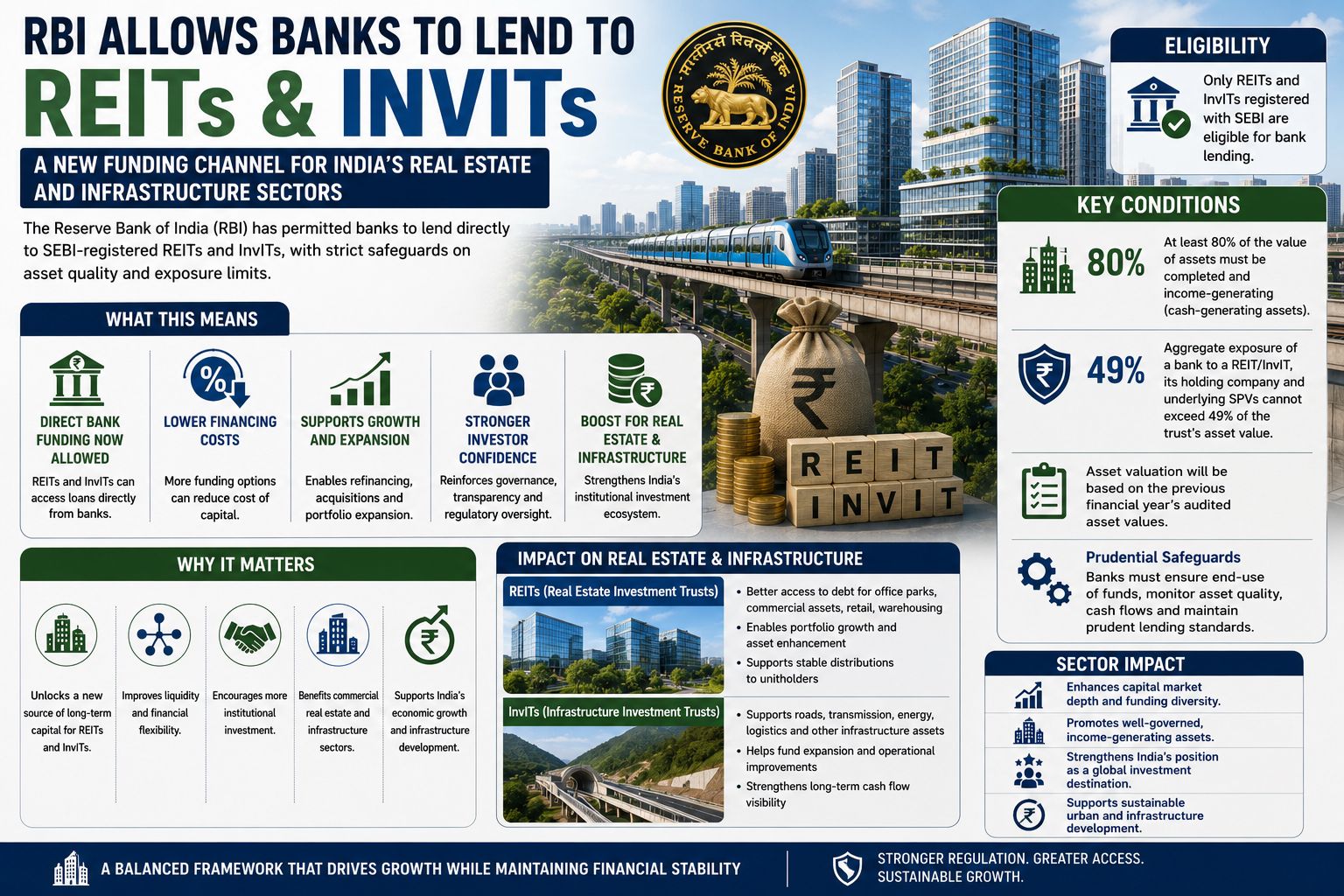
RBI Opens a New Funding Avenue for REITs and InvITs
In a significant regulatory reform, the Reserve Bank of India (RBI) has allowed banks to provide direct lending to Real Estate Investment Trusts (REITs) and Infrastructure Investment Trusts (InvITs). The move is expected to improve access to institutional funding for some of India's largest income-generating real estate and infrastructure portfolios.
Until now, REITs and InvITs primarily depended on bond markets, capital market fundraising, and financing at the underlying Special Purpose Vehicle (SPV) level. Direct bank funding at the trust level was not generally available, limiting financing flexibility.
The new framework is expected to reduce financing costs, improve liquidity, and provide an additional source of long-term capital for professionally managed investment trusts.
Only SEBI-Registered Trusts Will Qualify
The RBI has made it clear that only REITs and InvITs registered with the Securities and Exchange Board of India (SEBI) will be eligible for bank financing. The regulator's objective is to ensure that lending is directed towards entities operating within a robust governance and disclosure framework.
By restricting lending to regulated entities, the RBI aims to balance easier access to credit with financial system stability.
80% of Assets Must Be Cash-Generating
One of the most important conditions introduced under the framework relates to asset quality.
To qualify for bank funding, at least 80% of the value of a REIT's or InvIT's assets must consist of completed and income-generating properties or infrastructure assets.
This requirement is particularly significant because it directs lending toward mature assets producing stable cash flows rather than speculative or early-stage development projects.
For lenders, predictable rental income and operating cash flows reduce credit risk and improve repayment visibility.
For investors, the rule reinforces the core investment principle behind REITs and InvITs—ownership of operating assets that generate recurring income.
RBI Caps Overall Bank Exposure at 49%
While opening the sector to lending, the RBI has simultaneously introduced strict exposure controls.
Under the new framework, the aggregate exposure of a bank to a REIT or InvIT, including its holding companies and underlying SPVs, cannot exceed 49% of the trust's asset value.
The asset valuation reference date will generally be based on the previous financial year's audited asset values.
The cap is intended to prevent excessive leverage and reduce concentration risk within the banking system.
By linking borrowing limits directly to asset values, the RBI ensures that financing remains supported by tangible income-producing assets.
Prudential Safeguards Remain Central
The RBI's framework is not simply a relaxation of lending norms. Instead, it represents a controlled opening supported by multiple safeguards.
Banks will be required to:
- Monitor end-use of funds
- Ensure compliance with exposure limits
- Assess asset quality and cash-flow generation
- Maintain prudent credit evaluation standards
- Monitor underlying SPV structures where relevant
These safeguards are designed to prevent misuse of funds and ensure that bank financing is used for legitimate business and infrastructure purposes.
Why This Matters for India's REIT Market
India's REIT sector has grown rapidly over the past few years, with large institutional platforms owning office parks, business campuses, commercial assets, and retail properties across major cities.
The country's listed REIT market now controls a significant portion of India's Grade-A institutional commercial real estate. Access to bank financing could provide these entities with greater flexibility when refinancing debt, acquiring new assets, or managing capital structures.
Lower financing costs may also improve overall returns and support future expansion.
The move is widely viewed as a sign of increasing regulatory confidence in the REIT structure and its governance standards.
Implications for Infrastructure Investment Trusts
The benefits extend beyond real estate.
Infrastructure Investment Trusts, which own assets such as roads, transmission networks, renewable energy projects, and utilities, are also expected to benefit from improved access to long-term financing.
Infrastructure projects typically require substantial capital investments and long operating cycles. Additional funding sources can support expansion, refinancing, and operational improvements.
As India continues to invest heavily in transport, logistics, energy, and urban infrastructure, InvITs are expected to play an increasingly important role in funding these assets.
Potential Impact on Mumbai Real Estate
Mumbai hosts some of India's largest commercial office portfolios, many of which are owned or managed through REIT structures.
The RBI's decision could strengthen investment activity across office parks, business districts, and institutional-grade commercial assets in locations such as:
- Bandra Kurla Complex (BKC)
- Lower Parel
- Goregaon
- Powai
- Navi Mumbai
- Thane
Improved financing access may encourage additional acquisitions, upgrades, and expansion of income-producing commercial properties.
For investors, the move signals continued institutionalisation of India's commercial real estate market.
A Positive Signal for Capital Markets
The decision also reflects the increasing maturity of India's alternative investment ecosystem.
Globally, REITs are major participants in institutional real estate markets and typically enjoy access to multiple financing channels, including bank lending.
By aligning Indian regulations more closely with international practices, the RBI is helping create a more competitive financing environment for professionally managed real estate and infrastructure vehicles.
The reform is expected to improve liquidity, enhance financial flexibility, and strengthen investor confidence in listed REIT and InvIT platforms.
The Road Ahead
While the new framework opens fresh opportunities for growth, success will depend on how effectively REITs, InvITs, and banks utilise the additional financing flexibility.
The combination of direct lending access, asset-quality requirements, and exposure limits creates a balanced structure that supports growth while maintaining financial discipline.
As India's commercial real estate and infrastructure sectors continue to expand, the RBI's decision could become one of the most important regulatory developments supporting institutional investment over the coming decade.
Expert View
"Direct bank lending to REITs and InvITs represents a major evolution in India's real estate and infrastructure financing ecosystem. The RBI has struck a balance between improving capital access and maintaining financial stability through strict asset-quality and exposure norms. The move should strengthen institutional investment while supporting long-term growth across commercial real estate and infrastructure assets." — Sandeep Sadh